
Religious conversion and multiculturalism
A modest proposal about a recent trend

It seems that there have been a significant number of conversions to Roman Catholicism among Gen Z youth. The Washington Post has an article about it, as well as the Jesuit magazine America. Gavin Ortlund also recently put out a video on the subject on his Truth Unites YouTube channel. Interestingly, among the various causes for religious conversions among Gen Z youth, he lists the sense of a lack of belonging, direction, and identity.
I want to wade into these troubled waters with a proposal of my own. My suggestion is that multiculturalism of the sort that is practiced and cultivated in the Western world promotes religious conversion among youths because it takes away any clear sense of identity in non-religious terms.
How does it work? Very simply, as follows.
In the conditions of Western multiculturalism, national identity is completely stripped of any substantive ethnic or religious content. This means that people of whatever ethnic ancestry and whatever religious conviction can all equally lay claim to the title of “American” or “British,” for example.
For instance, people will say that there is nothing about being “American” or “British” that implies being white or black or whatever, being religious or not, being Christian or Muslim or Jewish, or whatever. This means that the notion of “American” or “British” is a quite thin one.
Of course, no country or society begins from a multicultural state. Multiculturalism is only ever imposed upon a particular culture after it becomes something notable and great, so that other peoples want to live in it, too. This is plainly what happened with America and with Britain. America became something notable because of the efforts of the British and other Western European colonists who founded it and developed it. Britain, too, became something notable because of the British people.
What is more, there is always an implicit recognition that the people moving into the culture to live there are not really of it, since they began as part of a different ethnicity and culture. This is especially evident when the incoming peoples do not look like the peoples who were already there, as for example there are clear physical differences between immigrants from Northern Africa, the Middle East, India, and Pakistan, on the one hand, and native Englishmen, on the other.
Thus, the incoming cultures always retain their prior identity, implicitly but also explicitly at times, even as they try to lay claim to the new adopted identity of the culture they’ve moved into. In America, this takes the form of “hyphenated Americans”—Mexican-Americans, Chinese-Americans, Indian-Americans, and so on—who inhabit two different cultures at the same time. The same dynamic takes place in Britain, as well.
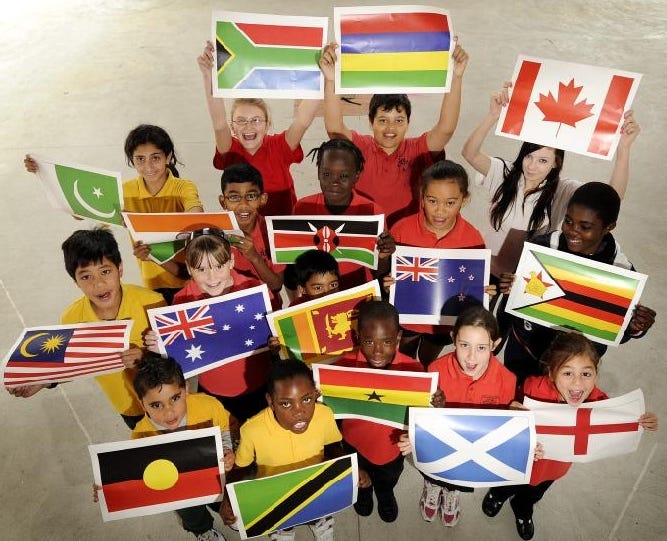
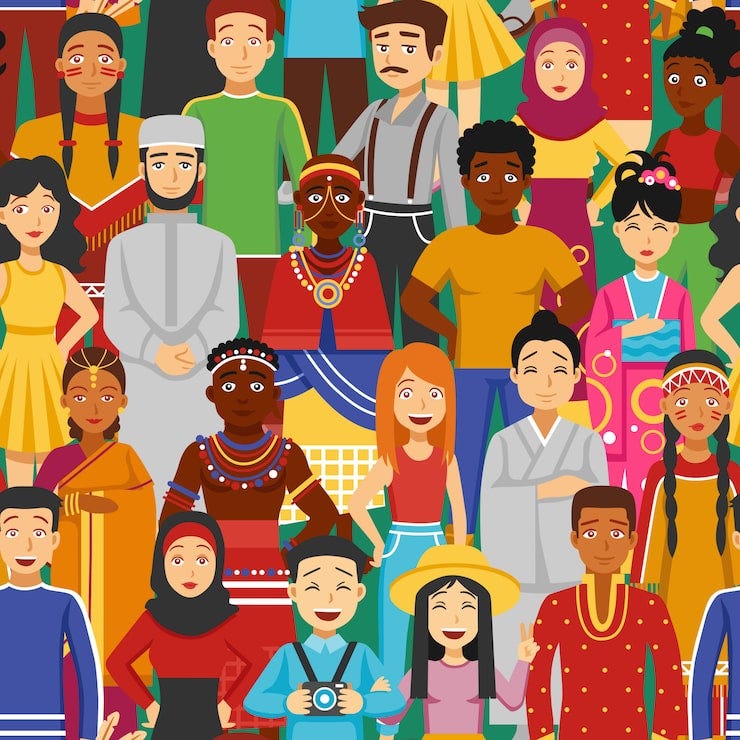
But multiculturalism means that the foreign cultures living in a place have as much a claim to belong there as the persons who were there first. A person of South Asian ancestry who is a citizen of America or of the United Kingdom is supposed to be just as American or as British a person of Anglo-Saxon ancestry.
This in turn implies that the original peoples which first advanced and made their own society into a great and notable place to live has no special claim on it. The English people have no special claim to England, and the descendants of the original colonists have no special claim or pride of place in America. Other people have just as much right to it as they do.
This convergence of forces creates serious disorientation and confusion in people. Someone whose ancestors date back to the thirteen original colonies is no more American than someone who arrived here ten years ago from Pakistan. Someone whose religion is Episcopal or Presbyterian Christianity is not more American than someone who worships Shiva, even though the former religious tradition was always present in America as a majority from the beginning while the latter was not.
The recently arrived immigrant from Nigeria has a culture and identity of his own, passed down from his parents and grandparents and ancestors. He also lays claim to the identity of American or British because he lives here and is a citizen, say. He has a systematic understanding of himself as being something definite and tangible, with a particular way of being in the world.
But the American or British youth growing up in conditions of multiculturalism is taught his entire life that there is nothing more to being an American or a British person beyond having a certain citizenship, perhaps, and being peaceably tolerant of cultural diversity.
So he has no culture of his own, no identity of his own, and is not taught a way of life by his parents and grandparents except that of not opposing any other ways of life. He is nothing in himself. His only purpose is to make space for other people with real identities to be themselves, even at his own cost.
And if that is how he is raised, why wouldn’t he turn to Roman Catholicism or some other religious tradition which gives him an identity and a sense of what he is? Why wouldn’t he accept citizenship and a real cultural belonging in heaven, if he can’t have it here on earth?
This is not to say that there couldn’t also be good reasons for thinking one particular religion is true. Moreover, the consideration of those reasons may play a significant role in convincing some people to convert.
My point is only that imposed multiculturalism—I call it “imposed” because no one ever voted for it—creates a situation of identity-related confusion and disorientation in people, for which a ready solution is conversion to a different religion that offers them a concrete identity and culture they did not grow up with.
I think some possible confirmation of my proposal lies in the fact that religious conversion often happens among the poor and dispossessed of societies.
For example, the pagan stereotype of early Christianity is that it was a religion of slaves, women, and children—people whose identities and place in ancient pagan society are the thinnest and least substantial, since they do not have much independence or agency to pursue their own goals in keeping with a well-defined personal identity. Slaves are just the property of someone else, children are just the children of someone else, women are just the women of someone else.
The same is true for the popularity of Buddhism in India. It was mostly popular with lower and outcaste individuals, who did not have robust notions of identity and culture of their own. They were rather there only to serve others in well-defined roles that were not particularly satisfying or voluntarily chosen.
If you are born into a robust and well-defined culture, given an identity that is substantial and furnishes you with goals to pursue that can be personally meaningful and satisfying to accomplish, i.e. if you have some robust notion of who you are and what you are about, there is little reason why you should convert to another religion. Why adopt a new identity when your present one works just fine?
It’s only if you have no real identity or sense of self, or else your given identity is personally unsatisfying because you are defined in such a way as to have no further purpose than serving others, that religious conversion becomes appealing. But unfortunately, that is precisely what happens when you tell European-descended Westerners that people who have nothing in common with them are just as American or British or whatever as they are, and that their real culture is multiculturalism and respect for differences. You are in effect telling them that they are nothing but hollow shells and servants of other people who are real people, with real identities and cultures.