

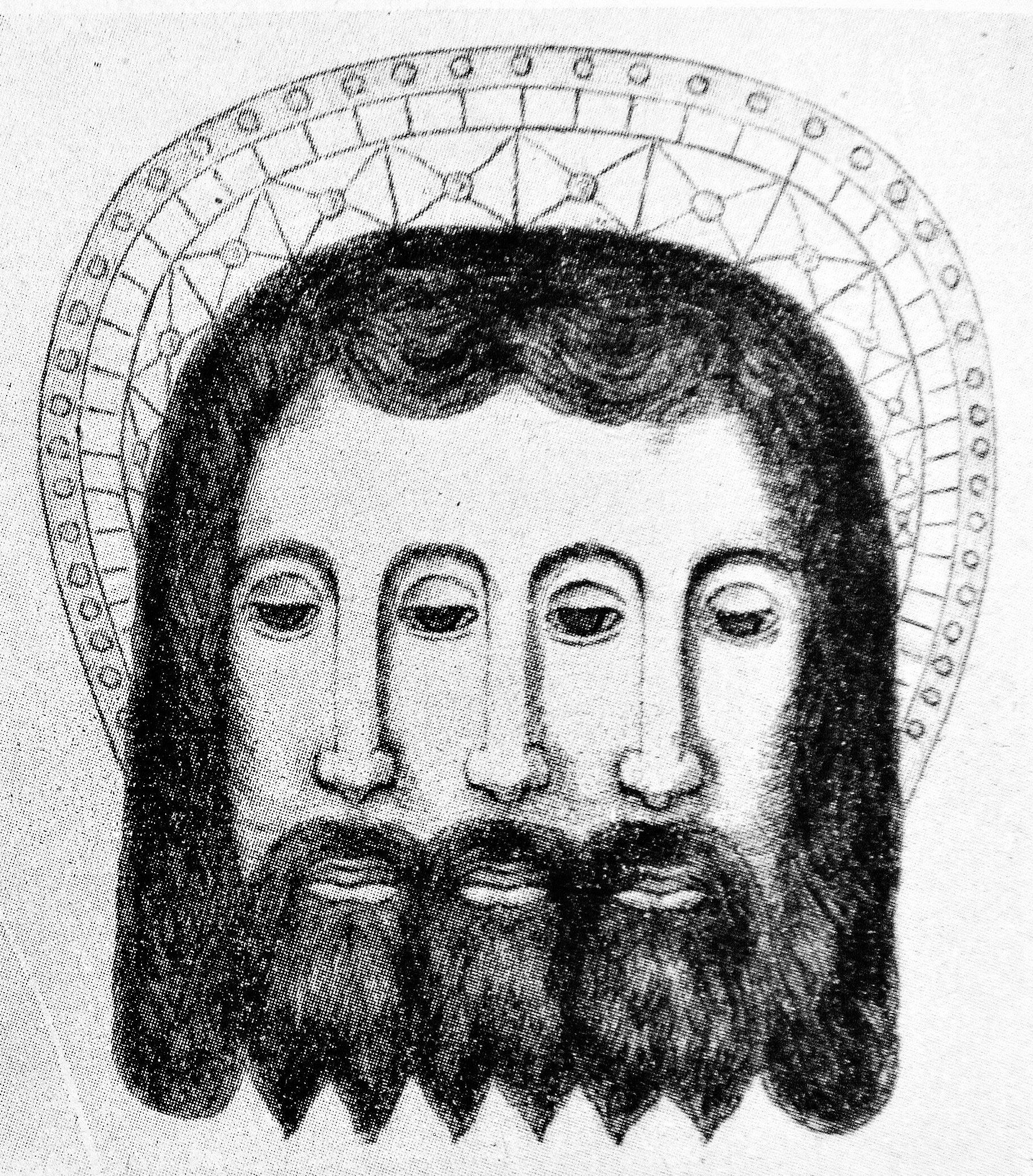
I’ve written extensively against the doctrine of the Trinity in the past, for example in my book Trinity and Incarnation (2023). Here is an argument that I’ve mentioned only briefly in previous works. It can be formulated as a series of questions.
Question 1: Does the Father beget a Son?
If we say No, then we are heretics. By saying No, we run afoul of the Nicene Creed, an ancient standard of orthodox doctrine, which says that the Son was begotten of the Father before all worlds (ἐκ τοῦ Πατρὸς γεννηθέντα πρὸ πάντων τῶν αἰώνων). So, to avoid heresy, we must say Yes.
Question 2: Does the Father beget a Son of the same nature as he?
If we say No, then we are heretics once more. The question at stake in the Nicene controversy was whether the Father and the Son are of the same nature, or else of different natures. The Nicene theologians insisted that the Son is “light from light, true God from true God, begotten not made, consubstantial with the Father” (φῶς ἐκ φωτός, Θεὸν ἀληθινὸν ἐκ Θεοῦ ἀληθινοῦ, γεννηθέντα οὐ ποιηθέντα, ὁμοούσιον τῷ Πατρί). The “Arians,” by way of contrast, insisted that there were differences of nature between Father and Son, whatever the similarities may be. Thus, in order to avoid heresy once more, we must answer this question with Yes.
Question 3: Does the Father beget a Son of the same nature as he by nature?
In other words, the question is asking whether it is a matter of the Father’s nature that he begets a Son of the same nature as he.
If we say Yes, then an infinite regress is produced. The Father would beget a Son by nature, and that Son, having the same nature as the Father, would in turn beget a Second Son by nature, and that Second Son, having the same nature as the Father and the Son, would in turn beget a Third Son, and so on ad infinitum. But in that case, we have an Infinity of persons and not a Trinity. So we cannot say Yes.
But if we say No, it is not by nature that the Father begets a Son of the same nature as he, then we must ask why he does it. There are two options. He could do it by will or without any cause at all.
If we say that the Father begets the Son by an act of will, then we fall into heresy. The act of will in question would not belong to the Father by nature, since we’ve already said that the Father does not beget the Son by nature. In that case, not belonging to him by nature, it must begin to exist at a certain point in time. How else could the logical distance between not having a property by nature and having it in fact be traversed except by the passage of time? But then there would be a time when the Son did not exist, namely just prior to the Father’s willing to beget him. And this would make us heretics once more, since the Nicene Council anathematized the opinion that “there once was a time when the Son was not.” So we cannot say that the Father begets the Son by an act of will.
Alternatively, we could give a second argument. If the Father begets a Son by an act of will and not by nature, then the Son’s existence would be contingent, since it depends on the Father’s decision to beget him. But in that case, the Son who exists contingently would have a different nature than the Father who exists of himself. And if we say the Son has a different nature than the Father, we are heretics once more. So we cannot say that the Father begets the Son by an act of will.
But if we say that the Father begets the Son neither by nature, nor by an act of will, then there is simply is no explanation for why the Father begets the Son. It would be a pure brute fact—something that happens to the Father apart from his will and nature, without his cooperation or consent, entirely ex nihilo. This presumably is unacceptable, since ex nihilo nihil fit—nothing comes from nothing.
Thus, the proponent of the orthodox doctrine of the Trinity is caught in a serious bind.
If he denies that the Father begets the Son, he is a heretic, since the Nicene Creed explicitly affirms that the Son is begotten by the Father.
If he denies that the Father begets a Son of the same nature as he, he is a heretic again, since the Nicene Creed explicitly affirms that the Father and Son are consubstantial.
If he says that it is by nature that the Father begets a Son of the same nature as he, then there will be an infinite regress of persons and not merely three. If the Father by nature produces a Son that has the same nature as he, then that Son will do the same and so on.
If he says that the Father begets a Son not by nature but by will, then he is a heretic again, since that implies there was a time when the Son didn’t exist.
And if he says that the Father begets a Son neither by nature nor by will, then he embraces pure brute facts over which God has no control. This is perhaps not officially a heresy, but it’s certainly incongruous with ordinary beliefs about God.